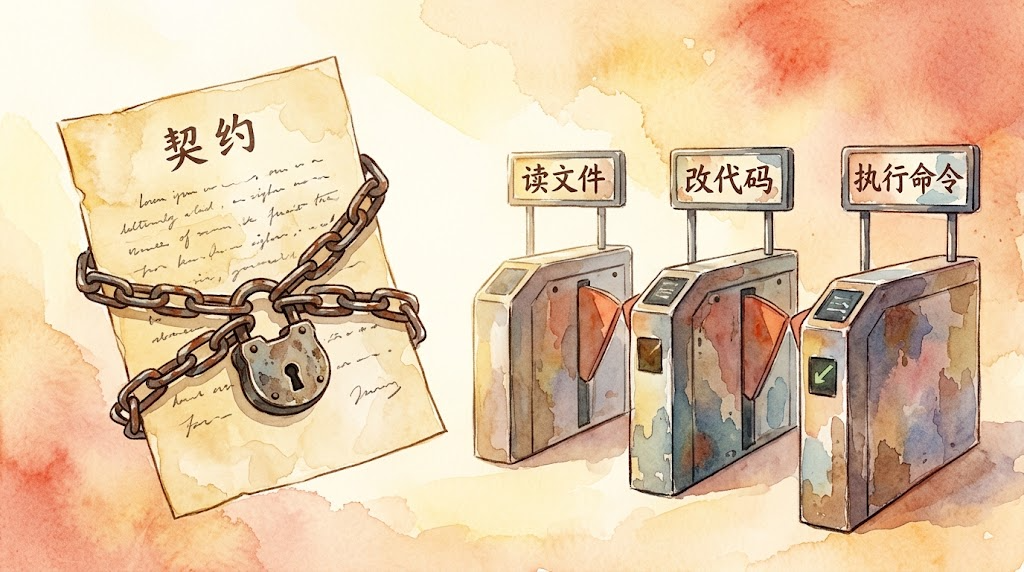
Watercolor style: A contract document locked with chains, beside three checkpoint gates labeled "read files", "modify code", "execute commands"

Day 3 | Harness Hard Constraints: Static Contracts and Lifecycle Hooks

Previous article: Day 2 | Minimalism and Hard Isolation: The Pi Paradigm. Now that we understand why Pi strips features, we now address a more specific question: after the cuts, how should the remaining capabilities be managed? This is the backbone article of L3. Navigation for subsequent articles: Day Type Topic Day 4 Practice Rewrite your AGENTS.md + add an interception Hook Day 5 Backbone Tools as Interfaces: Three Extension Paths Day 6 Practice Add a new tool to your Agent Day 7 Backbone Meta-Architecture: Everything is a Plugin Day 8 Backbone Memory, Traces, and Observability Day 9 Practice Graduation project: Build a team-level CI/CD automation Harness Day 10 Phase summary L3 graduation assessment + Harness future trends The Problem with “Allow Everything” Day 1’s miniharness had 7 tools; Day 2’s Pi cut it down to 4. Regardless of the count, they share a common premise: all tools are available by default. ...


2026-10-09 · 7 min · Alex Wang
Watercolor style: a clean workbench with only four tools neatly arranged, contrasted with a cluttered desk nearby

Day 2 | Minimalism and Hard Isolation: The Pi Paradigm

Previous post: Day 1 | 120 Lines to Understand the Agent Loop: miniharness Teardown and 3 Counterintuitive Findings. Now that we understand the loop’s core structure, let’s ask a more fundamental question: of the remaining thousands of lines, what belongs and what doesn’t? This is an L3 core lesson. Upcoming navigation: Day Type Topic Day 3 Core Hard constraints in the Harness: static contracts and lifecycle hooks Day 4 Exercise Rewrite your AGENTS.md + add an interception hook Day 5 Core Tools as interface: three extension paths Day 6 Exercise Give your Agent a new tool Day 7 Core Meta-architecture: Everything is a Plugin Day 8 Core Memory, traces, and observability Day 9 Exercise Capstone: build a team-level CI/CD automated Harness Day 10 Wrap-up L3 graduation assessment + Harness future trends Why “More Features” Is a Reverse Optimization In Day 1 we dismantled the loop, showing that the core logic takes only about a hundred lines; the remaining thousands consist of structure, constraints, tools, permissions, and planning modes—all the extra capabilities designed to let Agents “do more things.” ...

2026-09-28 · 6 min · Alex Wang
Watercolor: on a workbench, a small machine's translucent casing is lifted to reveal a glowing circular gear mechanism, two sealed black boxes standing beside it

Day 1 | 120 Lines to Understand the Agent Loop: miniharness Teardown and 3 Counterintuitive Findings

Previous post: Day 0 | L3 Kickoff: A Short History of Harnesses, From Your Batch Script to Pi and DeepSeek Harness. Make sure you understand the Harness concept from Day 0 and the API calls from L2 Days 0-3, and let’s start dismantling the loop. This is an L3 exercise post. Upcoming navigation: Day Type Topic Day 2 Core Constraints and interception: hooks and permissions Day 3 Exercise Adding an approval gate with hooks Day 4 Core Extensions vs plugins: Pi vs DSH Day 5 Exercise Writing a Pi extension Day 6 Exercise Composing DSH Cordis plugin modes Day 7 Core Agent Teams and task DAGs Day 8 Core Memory and learning: Hermes, Nowledge Mem, EvoMap Day 9 Exercise Designing your own skill system Day 10 Wrap-up L3 graduation check Why This Is an Exercise Post The previous post traced the evolution of Harnesses. From Anthropic’s controlled experiment to the Pi and DeepSeek Harness routes, we learned one thing. Beyond the model, that guiding structure is what actually decides success. ...

2026-09-07 · 8 min · Alex Wang