
TL;DR: On August 6, 2026, DeepSeek announced that it plans to raise API prices. No single cause: cost pass-through, user filtering, expectation management, free marketing, a shift to value-based pricing, and open-source ecosystem pressure all point at the same move. Rising compute costs are real, but they don’t explain the timing or the form of the announcement. The market is largely moving from winning share with low prices toward value-based pricing, and seven falsifiable signals before the official plan will confirm or overturn this post’s inferences.
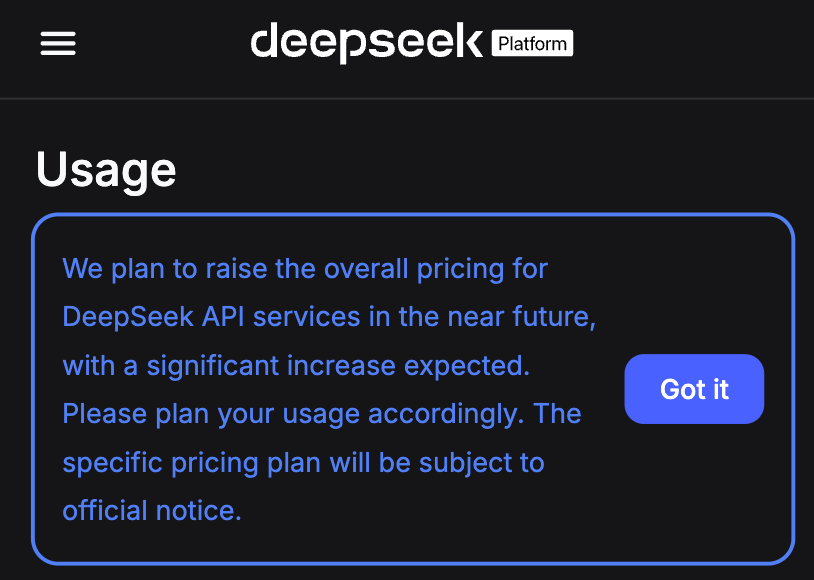
A one-paragraph notice about a future price hike might be the signal that China’s LLM inference market is entering a new phase. On August 6, 2026, DeepSeek announced on its website that it plans to raise API pricing overall, “by a relatively large margin,” with the specific plan to come [1]. No numbers, no effective date. Just the announcement that a formal plan is on the way.
Taken at face value, this is an ordinary pricing update. Placed on the timeline of the last few months of LLM inference pricing, it looks like something more. Most coverage attributes the hike to rising compute costs, and that is a real factor: GPU supply is still tight, inference demand keeps growing, and every major lab faces the same cost pressure [2]. But a business decision rarely has a single motive. Two questions are worth asking:
- Why is DeepSeek raising prices?
- Why is it announcing the decision in this manner?
These are two distinct questions. This post distinguishes facts, observations, and inferences: factual claims come from the official announcement or public sources, and explicit hypotheses come with a checklist of what we should observe if they hold.
One Move, Several Jobs at Once
There’s a term for what happens when multiple independent reasons point at the same decision: overdetermination. For a company, this is closer to the norm than the exception. A new subscription tier can simultaneously drive higher revenue, reshape the user base, align with a product launch, present a commercialization story to investors, and put pressure on competitors. The goals don’t exclude each other. The more objectives a single move fulfills, the more compelling it becomes. This post isn’t hunting for “the real reason.” The question is: which factors jointly pushed DeepSeek to this decision? Start with the industry context, then unpack the form of the announcement itself.
Why This Announcement Matters
A routine price change wouldn’t deserve a long post. This one matters because it’s the latest milestone in a series of shifts in the LLM inference market over the past few months: one vendor hiked API prices, another introduced tiered plans, a third reduced free allowances [3], while a fourth suspended sign-ups entirely due to capacity constraints [4].
Taken separately, these moves look unrelated. Together they point in one direction: the industry is gradually ending the phase of winning share with low prices and starting to talk about pricing itself. DeepSeek’s notice is part of that trend. The question worth watching isn’t the final percentage. It’s what this hike says about how AI commercialization is changing.
No Explanation, Just a Notice
First, a premise: DeepSeek gave no explanation for the hike. The notice consists of a single line stating that prices will increase overall by a relatively large margin, with a formal plan to follow. The “rising compute costs” attribution circulating online is not from DeepSeek; it’s a typical market guess, which holds some practical weight: GPU costs, inference demand, and model scale are real, industry-wide pressures. However, this raises a core question: if cost were the primary driver, why frame the announcement in this specific way? No numbers, no effective date. Just an early signal that prices are going up. The notice probably does more than pass along cost information.
The analysis has layers. Layer one is the circulating cost story. It’s real, but it doesn’t explain the timing. Layer two is what price itself does. Layers three and four focus on the function of the early announcement preview. Layer five is the direction of the increase. Each layer stands on its own; together they form the full picture.
Cost Pressure Is Real, but It Doesn’t Explain the Timing
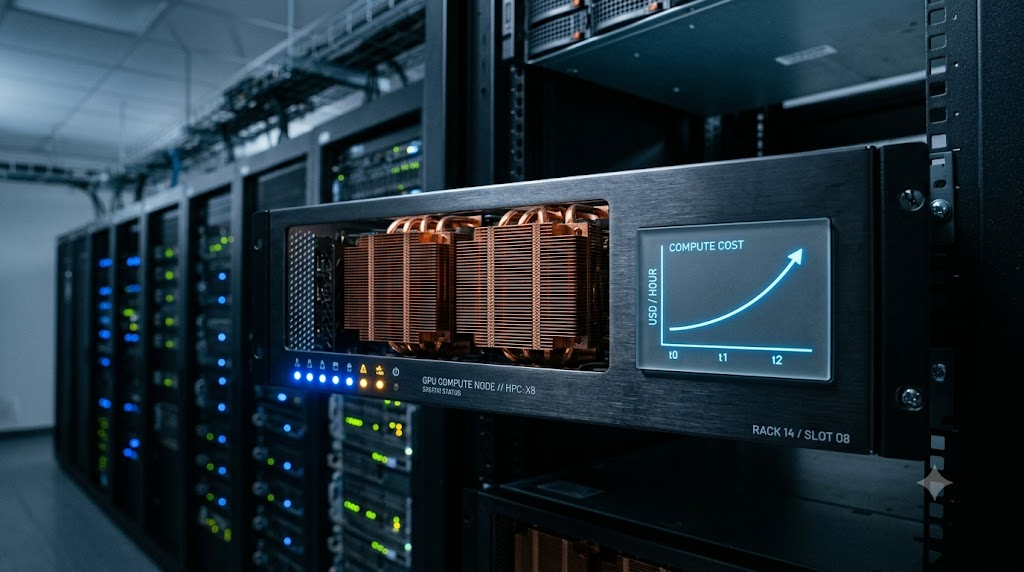
DeepSeek’s notice assigns no cause. It only says API pricing goes up overall, with the formal plan to follow [5]. Meanwhile, over the past year neither NVIDIA GPU supply nor global inference demand has eased. Inference has begun to overtake training as the main cost driver for a growing number of AI model developers [2]. OpenAI, Anthropic, Google, and Meta have all talked publicly about inference cost and efficiency [2]. While compute pressure is undeniably real, relying on it alone leaves key temporal questions unanswered:
- Why not two months ago?
- Why not on the day the formal plan is published?
- Why announce it in advance?
Cost explains “why raise prices.” It doesn’t explain “why now.” Since cost can’t explain the timing, the next layer looks at what price itself is doing.
If this layer holds, we should see:
- an explicit citation of cost in the formal notice or official follow-ups (which is missing in this preview);
- an increase roughly in line with observable changes in inference costs (a significant overshoot would point beyond cost);
- coordinated price adjustments by other vendors on the same GPUs (industry-wide pressure strengthens the cost story, while a solo DeepSeek hike weakens it).
Price Itself Is a User Filter
LLM APIs have an odd property: every call costs real compute, but not every call creates revenue. Platforms offering generous free tiers or sub-market pricing tend to attract trial users, automated tests, benchmark loops, one-off projects, and free-tier farming. All of those consume GPUs, and most never convert to long-term revenue.
High-value users account for a small fraction of traffic
Public statistics have suggested that under some measures, a large share of DeepSeek’s token consumption comes from free allowances, with paid calls clearly below free calls. (Metrics differ by methodology, so treat this as a trend observation, not official data.) If that holds, a lot of GPU capacity is serving low-value requests, and the people actually building products are only a fraction of the traffic.
That’s where price starts to do a second job: not just earning money, but filtering. There’s an old line in economics: price is a filter [6]. It serves a dual function by generating revenue while filtering the user base. Businesses that genuinely depend on the API don’t stop over a 20% increase; the “just trying it out” traffic drops immediately. The platform gets two results: less GPU pressure, and a remaining request mix that looks more like real production load.
Why this matters for training data
There’s an easy-to-miss angle here. For today’s models, the most valuable data is concentrating in agent workflows: a single request chaining search, tool calling, multi-step reasoning, error recovery, and long context. Those requests are fewer but far denser than casual chat. If price naturally filters out one-off trial users, what remains is closer to enterprise usage. Price filters users, and by extension, it filters the sources of future training data.
Peak/off-peak pricing is filtering too
DeepSeek has already experimented with peak/off-peak pricing [1]. Most people read that as load shifting. There’s a second meaning: interactive users want answers “right now,” while batch enterprise jobs can run at 3 a.m. Price structure changes user behavior, and what remains is increasingly schedulable, automatable, long-running workloads. If DeepSeek widens the peak/off-peak spread, it’s optimizing the overall traffic shape. Revenue is only part of the goal.
If this layer holds, we should see:
Whether this layer holds shows up directly in the shape of the formal plan: whether it includes these elements:
- free allowances tighten further;
- the peak/off-peak spread widen;
- more enterprise plans;
- more discounts aimed at agent scenarios.
If none of these appear in the formal plan, the “price as filter” inference needs revisiting. And if the price structure is already filtering users, the cadence of the preview is probably engineered too. Which brings us to the next question: why announce the hike without the numbers?
Why Announce a Hike Without the Numbers?
This might be the most interesting part of the whole notice. If the price is decided, why not publish it? One plausible answer: DeepSeek is managing expectations first. Signaling that “prices will increase,” without releasing specific figures allows the market to anchor its cost expectations early. When the plan lands, the conversation shifts from “why the surprise increase?” to “more or less than I expected?”
It’s a familiar rhythm from internet product launches: split one price shock into two news cycles. Announce the hike, then announce the number. Each gets media coverage, while the backlash is diluted. It’s also how many SaaS companies update pricing.
If this layer holds, we should see:
- The formal notice should frame the hike with a rationale, or “promotional pricing ends” wording, steering the conversation toward “more or less than I expected?” (see Signal 3 on wording in the checklist below).
- The gap between preview and formal plan: a short gap (days) means the price was already decided and the preview exists to split the news cycle; a long gap means the decision is still being made.
- Whether the formal notice explains “why” will be crucial, as expectation management usually comes with an explicit rationale. If the formal plan is still just numbers with no rationale, this layer’s explanatory power needs revisiting.
Managing expectations explains half the cadence. The other half is distribution: the preview is itself free marketing. That’s the next layer.
The Announcement Is Itself Free Marketing
A price-hike notice has a side effect that’s easy to overlook: it spreads almost by itself. If DeepSeek had quietly updated its API pricing page today, many developers wouldn’t notice for days. Instead, the company announced:
“Prices are going up.”
The media reports, developers discuss, social platforms speculate, and competitors pay close attention. The whole industry enters a waiting state for the formal plan. For a tech company, that kind of attention is a scarce resource.
Why “will raise prices” spreads better than “raised prices”
Internet product marketing shares a common dynamic: uncertainty drives engagement. An Apple keynote generates more buzz before the event than on the day, because everyone is guessing. A price preview creates three questions:
- How much?
- When?
- Who’s affected?
Until the answers arrive, the discussion doesn’t stop. A few dozen words of announcement can buy days or weeks of exposure.
One message, different audiences
For developers:
Should I top up my balance early?
For enterprises:
Should I lock in a budget?
For the press:
Will this reset China’s API price structure?
For investors:
How does the hike change the company’s valuation math?
For competitors:
Should we launch a migration promo during the window?
One announcement, many groups activated. That’s a wider reach than a typical product launch.
DeepSeek Itself Is the Message
Everyone discusses “the price hike”; the exposure accrues to DeepSeek. Many developers hadn’t visited DeepSeek’s site in months; the notice brings them back to check pricing, compare models, read docs, re-evaluate migration. The announcement pulls developers back to the product. From an attention standpoint, that’s a highly effective way to recapture developer focus.
If a new flagship model is coming, the story completes itself
Suppose before the formal plan, DeepSeek ships a new flagship and announces formal prices, new plans, and enterprise options. Then today’s notice isn’t an isolated event. It’s step one of a product launch. Many tech companies follow the same cadence: a signal on day one, the product a few days later, prices after that, a one-to-two-week cycle. Three rounds of media, three rounds of community discussion, three rounds of exposure. Compared to dumping everything in one day, the drip is more efficient.
To be clear, while marketing may not be the primary driver, it remains a powerful byproduct of this announcement format. Mature internet companies design business decisions to capture both benefits. If a move improves revenue and earns industry attention, there’s no reason to leave the second on the table.
If this layer holds, we should see:
- increased publication of API and capability updates on official channels;
- developer invitations issued to beta-test a harness product;
- technical blog posts shifting focus away from price explanations;
- online talks, livestreams, or developer events;
- the price change bundled into a broader product update.
As of publication, an unconfirmed post on Reddit’s r/DeepSeek suggests that DeepSeek has begun inviting developers to beta-test a harness product [7]. The other signals haven’t moved yet.
If the result is just a price notice with no supporting moves, the marketing effect is more likely to be incidental than planned.
Cadence and form covered. That leaves direction: where does the price level come from? That’s about product value.
Value-Based Pricing
Now the other question: why are so many AI companies revisiting pricing? Because the product changed, not the GPU. For the past year, the biggest competitive advantage among models was one word: cheaper. Everyone cut prices, grew free allowances, lengthened context, and raced for market share. That strategy has a premise: a company willing to subsidize long-term. As the industry enters its next phase, standard questions shift to: what capabilities are users truly willing to pay for?
That’s value-based pricing [8]. A model that merely answers basic queries commands limited pricing power, whereas one capable of executing complex agentic workflows, multi-step coding, and deep research redefines value entirely.
Software has been through this cycle before. Early SaaS grew on free tiers, ultra-low prices, and subsidies; later the metrics that mattered were ARPU, paid conversion, retention, and enterprise revenue. Many SaaS products raised prices after shipping new capabilities, because the conversation changed from “why is this more expensive” to “what are these capabilities worth.” AI is repeating the process, just faster.
If this layer holds, we should see:
- A new flagship lands in or near the hike window, switching the story from “cost pressure” to “product upgrade” (see Signal 2 in the checklist below).
- The formal plan ties price to capability: enterprise plans, per-task pricing, agent-scenario pricing, not just a flat per-million-token increase on the same model.
- If the hike is only a token-price increase on an unchanged model with no new capability vehicle, value-based pricing loses explanatory power, and “cost + commercialization” gains it.
If DeepSeek’s next flagship lands near the hike window, the story switches from “cost pressure” to “product upgrade”: the classic value-pricing narrative, and the classic software-industry price upgrade. Whether that story holds depends on the signals before the formal plan, which is the observation checklist in the next section.
What Happens Before the Official Plan Matters More Than the Final Number
For developers, the per-million-token price matters. For industry watchers, what matters is: what does DeepSeek do before the formal plan? Business decisions rarely start at the official announcement; changes happen early. The signals below will decide which of this post’s inferences hold and which need revision.
Signal 1: Do Free Allowances Tighten First?
This is the most important signal. Compared to reworking the whole price system, cutting free allowances has almost no technical cost, and it immediately reduces GPU pressure, thins out the free-tier farmers, reveals user churn, and tests the market. If DeepSeek faces inference-resource pressure, free allowances likely change before official prices. That’s the top signal in this window.
Fewer free tokens means the company cares about GPU utilization. Unchanged free allowances with a pure price increase means commercialization is the bigger goal.
Signal 2: Does a New Flagship Land in the Hike Window?
Many SaaS companies pair a product upgrade with a price upgrade. The value-pricing logic: when a model gets visibly better, users accept a price increase more easily. The question to watch: does DeepSeek release a new flagship before the formal price increase? If yes, the story shifts from “the same product suddenly got more expensive” to “a new product, a new price.” This is falsifiable: if no model upgrade arrives within a month, the value-pricing inference needs reassessment.
Signal 3: How Is the Official Notice Worded?
Everyone watches the numbers; the wording matters too. “Price increase” and “promotional pricing ends” feel very different. If the official language emphasizes “returning to standard pricing,” part of today’s increase is just a promo ending [9]; if it says “an overall price adjustment,” a new price system has formed. Many SaaS companies spend a lot of time on that one sentence. The narrative is part of the product.
Signal 4: Do Competitors Start Poaching?
Watch the other vendors. Everyone will see the window: migration promos, free allowances, SDK compatibility, one-click migration. All of it lowers switching cost. If a wave of “DeepSeek-API-compatible” marketing appears, the industry has already treated this hike as a user-acquisition window.
Signal 5: Do Third-Party Inference Platforms Get More Aggressive?
This is the biggest difference between DeepSeek and closed models: the weights are public, so users never have to leave DeepSeek. They only have to leave the official API. Watch whether Alibaba Cloud, Volcano Engine, SiliconFlow, Together AI, and OpenRouter start emphasizing cheaper, more stable, DeepSeek-compatible offerings. If that happens at scale, the official API is fighting the whole inference ecosystem, and other models are only part of it.
Signal 6: The Community Starts Doing Math
Every price change gets re-calculated by the community: old per-million-token prices, the delta after “returning to standard,” the extra annual budget for enterprises, spreadsheets across HN, Reddit, and X. Those discussions feed back into the official messaging. Don’t underestimate developer communities; they’re part of the price system.
Signal 7: Stability Problems May Precede the Price
A rarely discussed angle: even before the official price, if GPUs get tight, users feel slowdowns first. The hike comes later. First-token latency climbing, request queuing, rate limits, more errors, peak-hour jitter. If these appear before the price, resource pressure is more urgent than commercial strategy. This is one of the most worth-watching technical signals in this post.
These Signals Will Confirm or Refute the Hypotheses
The real value of tech analysis is proposing falsifiable predictions. This post is an attempt at business observation: placing DeepSeek’s price preview into the industry cycle, unpacking the multiple goals it may serve, and listing falsifiable signals. If the signals show up over the window, the user-filter, value-pricing, marketing-cadence, and commercialization-turn analyses gain credibility. If none of them show up, the hypotheses in this post should be revised. What DeepSeek does during the window will directly test these inferences.
Price Is Becoming Part of the AI Product Again
Zoom out, and DeepSeek’s hike isn’t an isolated event. Over the past year, nearly every major lab, domestic and international, went through the same arc. Phase one: compete on who’s cheaper. Prices fell [3], free allowances grew, context lengthened, some quotes approached or went below cost to buy developer growth. Back then, everyone was buying market share.
That model has a natural end. When model capabilities converge, inference demand grows, and GPUs stop being infinite, the industry has to answer: who will actually pay? Competition shifts from “who’s cheaper” to “is it worth it.” To a large degree, the LLM inference market is moving from winning share with low prices toward value-based pricing, and DeepSeek’s hike is a node in that turn. Over the next few years, the question stops being which model benchmarks 2% higher, and becomes which company can build its own price system. Price is part of the product; it tells the market where the company believes its value is.
Developers are buying outcomes, not tokens. The old API discussion was about per-million-token price. The future discussion may be what a completed agent, a coding task, or a report costs. Users buy results, not inference [10]. What sustains a price increase shifts from more parameters to a stronger ability to complete work.
DeepSeek’s challenge may be just beginning. If its biggest advantage was extreme cost-performance, then after the hike it must answer: besides being cheap, why should developers stay? That question matters more than the size of the increase: a price advantage lasts a year; a product advantage lasts many. Meanwhile, open source gives DeepSeek a unique constraint: closed models can raise API prices and users have few alternatives; open models are different. When the official API goes up, developers can self-host or migrate to a third-party inference platform running the same model. What limits DeepSeek’s pricing power isn’t just OpenAI, Anthropic, Kimi, and GLM. It’s the entire open-source inference ecosystem. DeepSeek is competing with the people running its own models. That’s the shared problem of all open-source commercialization.
The Bottom Line
Back to the original question: why is DeepSeek raising prices? The most accurate answer: when compute costs, commercialization pressure, product upgrades, financing windows, competition, marketing, and the industry cycle all point at the same move, the hike becomes the natural choice. No single factor is the cause. For industry watchers, the direction is worth recording: AI is slowly ending the era of buying growth with low prices.
The “financing window” layer deserves a separate note, because it rests on market reports, not official confirmation. Reports say DeepSeek is working on a second funding round: according to unnamed dealmakers, around RMB 50 billion raised at a pre-money valuation of about RMB 500 billion, targeting a signing in late August, with the round reportedly paused in late July. The same report also states, as aggregated media disclosure, that DeepSeek’s ARR has reached USD 400-500 million and that its gross margin on V4 exceeds 50% [11]. These numbers need to be read in tiers: the round size, valuation, and timeline come secondhand from anonymous dealmakers, and the actual signing could change or fall through; the ARR and margin figures are media disclosure with no other source found to cross-check. But even if the exact numbers are wrong, the fact that the hike landed inside a financing window is worth watching on its own. Announcing a price increase before a round is signed improves the revenue and margin story, which helps valuation talks. This layer is falsifiable too: if funding news matches the timeline described here, it gains credibility; if the funding reports are denied, this layer should be dropped.
References
- DeepSeek API Documentation: Pricing
- Reuters, via Bloomberg: “Chinese AI startup DeepSeek developing own AI chip, Reuters says” (2026-07-07)
- Axios: “DeepSeek’s new bargain model accelerates AI’s race to zero” (2026-08-01)
- AP News: “China’s Moonshot AI halts new subscriptions after surging demand”
- DeepSeek API Documentation: Updates
- Nagle & Müller, The Strategy and Tactics of Pricing, Routledge
- Reddit r/DeepSeek: developers invited to beta-test a harness product (community post, unconfirmed)
- Ramanujam & Tacke, Monetizing Innovation, Wiley
- Reuters: “China’s DeepSeek slashes prices for new AI model” (2026-04-27)
- Chen et al., “The Price Reversal Phenomenon: When Cheaper Reasoning Models End Up Costing More”, arXiv
- Wallstreetcn (华尔街见闻): “DeepSeek officially announces a price hike, by a relatively large margin!” (2026-08-06, 11:51). Republished by Tencent News; also on NetEase