
TL;DR: Five constraints shaped the Watchdog-Intervention Bridge’s cross-language architecture. Watchdog must intercept LLM tool calls synchronously, so it runs in TypeScript. Intervention must reuse the existing reflection engine and rule system, so it stays in Python. The Bridge adds zero new infrastructure, so it uses subprocess. Communication can’t block every tool call, so batching replaces real-time streaming. MCP’s subprocess model already handles failure, so cross-language risk stays contained. Each decision was the least bad option under the circumstances.
The last post covered what the Watchdog-Intervention Bridge does in Aristotle v1.6. This one is about why it looks the way it does.
A seemingly odd choice
The most visible design decision in the Watchdog-Intervention Bridge is that Watchdog is written in TypeScript and Intervention is written in Python. One system, two languages.
If you only look at language preferences, this doesn’t look optimal. Cross-language means:
- Two development environments, two dependency management systems, and two testing frameworks.
- An extra layer of serialization and parsing for the communication protocol.
So why go this way?
Constraints shaped every decision here. Each choice was the least bad option available given specific constraints.
Constraint 1: Watchdog must be synchronous
Watchdog’s job is to intercept the LLM’s tool call path. Specifically, onToolBefore needs to evaluate rules before a tool runs. If there’s a violation, it uses throw to stop the tool synchronously.
This requirement rules out almost every cross-process approach. You can’t await a remote call result in the middle of a tool call path. Every wait stalls the LLM’s next operation. Even a few milliseconds of latency per communication adds up quickly across the whole pipeline.
TypeScript is the host language for LLM tool calls. Putting Watchdog on the TypeScript side lets onToolBefore read pipeline state directly and throw synchronously on violation. Nothing extra waits on the call chain.
If Watchdog were on the Python side, every tool call would need cross-process communication just to check for violations. The communication overhead alone would make synchronous interception impractical, before even accounting for Python-side latency.
Watchdog had to be written in TypeScript because the runtime environment required it.
Constraint 2: Intervention’s assets and ecosystem are in Python
Intervention’s core logic is matching rules, detecting violations, and dispatching interventions. Aristotle v1.0 through v1.5 accumulated a rule system, Knowledge Item (KI) document management, and root cause analysis logic on the Python side, with 1166 test cases written in pytest.
Putting Intervention in Python means these assets survive intact. The rule engine carries over, along with the violation type handlers and all 1166 tests.
So why not TypeScript? Breaking down the tradeoff shows why the system ends up with two languages.
Intervention in Python:
- Zero rewrite cost: all 1166 tests, the rule engine, violation handlers, and KI document management are preserved.
- Then there’s the pytest parametrize and fixture ecosystem. pytest’s
@pytest.mark.parametrizesupports stacking decorators to generate Cartesian products, while fixtures provide dependency injection with automatic teardown. Vitest’sit.eachonly handles single-level parameterization with no equivalent to pytest’s fixture system. For 13 violation types tested in combination,@pytest.mark.parametrizemakes the test code significantly more compact.
Intervention in TypeScript: The benefit is a unified development experience:
- A single language means no cross-language communication.
- One development environment and one dependency management system cover the whole toolchain.
This is a tradeoff between one-time and ongoing cost. Rewriting 1166 tests is a large one-time cost. Cross-language communication is an ongoing but manageable cost. The Bridge only triggers at checkpoints, once per interaction cycle.
One clarification: Intervention exposes itself as an MCP tool, and MCP has both TypeScript and Python SDKs. MCP’s subprocess protocol means the communication pattern is independent of language choice. Whether Intervention is in Python or TypeScript, it communicates with Watchdog the same way: via subprocess, with identical latency and stability characteristics. So “cross-language communication” isn’t an argument against Python here. The communication cost is determined by MCP’s protocol, not by the language.
Asset reuse outweighed cross-language maintenance cost in the final decision.
The remaining design decisions were about how to connect them.
Constraint 3: Zero new infrastructure
There are several common approaches to cross-language communication:
- IPC (Unix domain socket or named pipe): Requires managing socket lifecycle and concurrent connections.
- HTTP server: Requires starting a lightweight server, managing ports, handling request queuing, and handling service crashes.
- Subprocess: A child process starts when needed, runs, and exits, with no state management.
Adding IPC or HTTP to an existing project introduces new failure modes, including socket disconnections, unexpected process exits, and port conflicts. All of these have standard solutions, but the complexity doesn’t go away. You still need to manage it.
Running a subprocess is the most direct option because it executes on demand without requiring connection pools, persistent state, or port allocations. Failure detection is straightforward: a non-zero exit code means failure. There’s no need to distinguish between “the service is down” and “the request timed out.”
Aristotle also already had the callMCP() pattern in idle-handler.ts, which calls Python modules through subprocess. This pattern had proven stable in production. There was no reason to introduce new infrastructure.
The Bridge uses subprocess. Startup costs about 400ms per launch.
Constraint 4: 400ms can’t block every tool call
Subprocess takes about 400ms per launch. If every tool call triggered a subprocess to communicate with Intervention, the accumulated overhead would noticeably increase pipeline latency.
This calls for a buffering strategy. The TypeScript side buffers violation signals in the audit log first. When a checkpoint is called, it sends them to Python in a batch.
This strategy has a technical prerequisite. onToolBefore doesn’t need to wait asynchronously for Python to make its decision. It can detect violations and throw on its own. Only Intervention decisions (quarantine, rollback, suspend, instruct) need Python processing. Those don’t need to happen in real time on the tool call path.
onToolBefore/onToolAfterdetect violations synchronously and write signals to the audit log.- When
tdd_checkpointis called, the violation gate reads the accumulated audit logs in bulk and sends them to Python via subprocess. - Python returns an
InterventionResultand TypeScript applies the decision. - When no violations occur, there’s no overhead from signals or subprocess launches.
Batching keeps latency acceptable by absorbing the fixed 400ms cost at checkpoints rather than at every tool call.
Constraint 5: MCP’s subprocess model makes cross-language risk manageable
Does placing Intervention in Python instead of TypeScript introduce more complexity than it eliminates?
The answer is no, because Intervention exposes itself as an MCP tool. MCP tools run as subprocesses by design: the host sends a request, the tool executes, returns a result, and exits. If the call times out or the process crashes, it returns an empty result and the host decides what to do. This contract works well with cross-language communication.
In practice:
- When the subprocess call fails, the Bridge returns an empty MCP envelope. The TypeScript side handles it as a standard MCP response, with no special fault tolerance needed for Python failures.
- When a violation occurs, the violation gate writes to the audit log without checking whether the Python process is running. A failed subprocess affects intervention completeness, not interception.
- Whether Intervention is in Python or TypeScript, MCP’s protocol defines the boundary between it and Watchdog. That boundary already includes failure handling.
The “cross-language adds complexity” argument overlooks the role MCP’s protocol plays. Intervention uses Python because MCP’s protocol already handles the cross-language part.
Bonus: Stub-first decision
One more decision deserves mention. v1.6 added 15 new MCP tool definitions (moving them from initial concept to defined stubs). Combined with the 10 active tools from v1.5, the total reached 25.
The 15 new tools (10 for rule lifecycle, 2 for KI documents, 3 for rollback) started as stubs in early development. They appeared in the tool list, but calls returned “not implemented.” This might look incomplete. If all 15 tools were going to be implemented anyway, why not build them completely from the start?
The core objective of v1.6 was to implement the Watchdog-Intervention Bridge. The MCP tools were infrastructure enhancements. There was no point building all 15 tool stubs before Watchdog was operational.
The stub-first approach reserves a spot on the roadmap. The AI sees the list and knows the tools are coming. For everyone else, the stubs signal what’s planned without pretending the work is done.
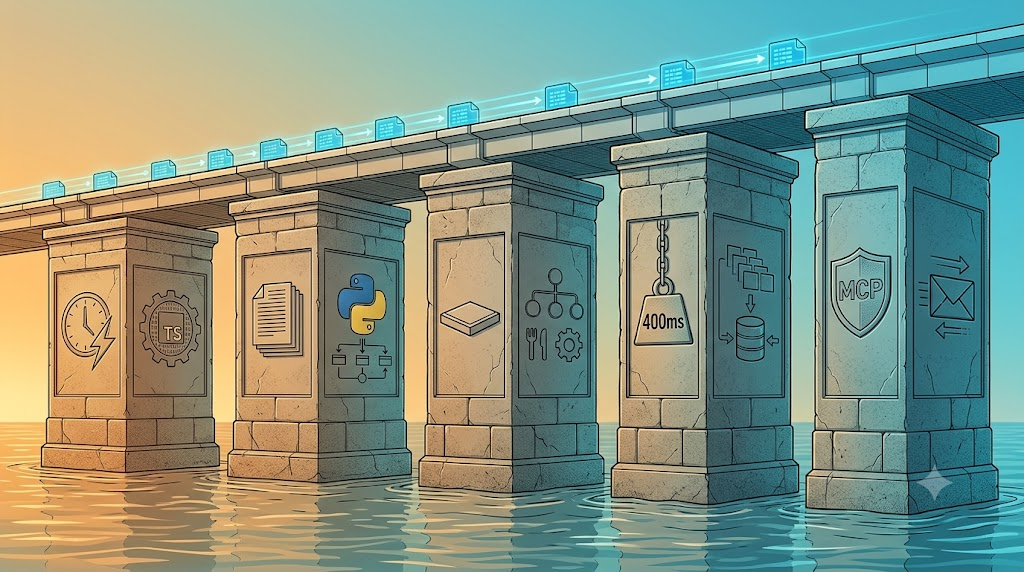
Design under constraints
| Decision | Constraint | Chosen |
|---|---|---|
| Watchdog language | Synchronous interception, host environment | TypeScript |
| Intervention language | Existing assets, testing ecosystem | Python |
| Bridge mechanism | Zero new infrastructure | Subprocess |
| Communication mode | Tool-call execution overhead (400ms startup) | Buffering + batching |
| Fault tolerance | MCP’s subprocess model handles cross-language risk | Empty envelope + decoupled audit logging |
None of these five decisions were ideal. Each was the least bad option the constraints allowed.
Constraints eliminate what looks good in theory. Finding what still works under those constraints is the actual task.
The philosopher Aristotle called this pursuit “the good.” A system that runs and keeps working under real constraints is what an engineer would call the same thing.