Watercolor style: an open notebook with five card-shaped slots, three filled with colored cards and two blank, scattered sticky notes nearby, a warm cream desk surface

Today's Practice: Organize Your First 5 Prompts

Today’s Practice From your recent AI conversations (coding, writing, analysis), pick 5 prompts that actually worked well. Record them using the template from Part 4: Original Prompt + Effectiveness + Iteration. Where you record them doesn’t matter. A notes app, Notion, or a plain text file all work. Don’t overthink the tool. If you can’t find your chat history, spend 20 minutes creating 5 prompts you’ll definitely use at work. For example: “Check the edge cases in this code,” “Rewrite this technical article for beginners,” “Extract the 3 main issues from these 100 pieces of user feedback.” ...

2026-05-27 · 2 min · Alex Wang
Watercolor style: a neatly organized workbench with labeled glass jars, a leather journal, curated tools, and a two-drawer cabinet symbolizing tiered knowledge management

AI Path L0→L1 Upgrade Guide (4): Building Your Personal System

📖 This is Part 4 of 5 in the “AI Path L0→L1 Upgrade Guide” series. Part 1: Understanding Your Tools · Part 2: From Vague Questions to Precise Instructions · Part 3: Turning AI Into Your Collaboration Partner · Part 4: Building Your Personal System · Part 5: Graduation & Next Steps Over three weeks you’ve picked up follow-up questions, context management, role-playing… the skills are piling up, and here’s the problem: how do you manage all these scattered abilities in one place? Week 4 is about exactly that: building a prompt library, choosing the right tools, and setting up knowledge management. Turning what you’ve learned into a personal system. ...

2026-05-26 · 4 min · Alex Wang
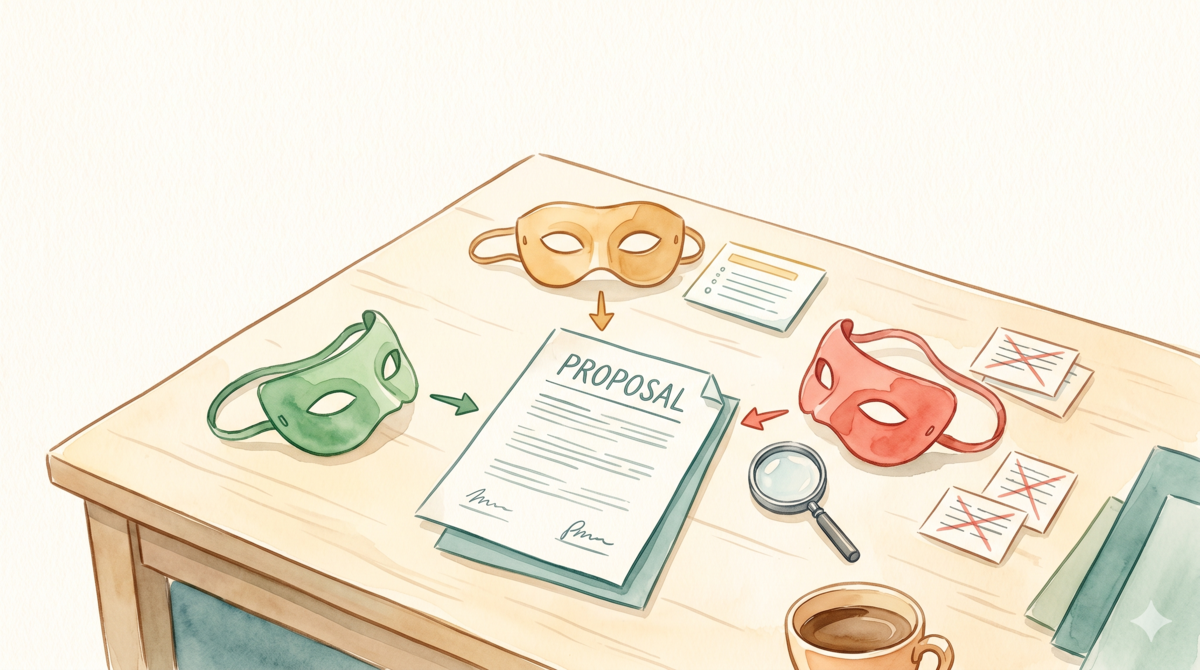
Watercolor style: a proposal document on a wooden desk surrounded by three theatrical masks (green supporter, red critic, amber neutral) in triangular formation, symbolizing role-playing to expose blind spots

Role-Playing in Practice: Make AI Your Devil's Advocate

Yesterday’s discussion covered follow-up questions: three questions to dig out the hidden assumptions behind an AI answer. The catch is, you need to know what to ask. Some blind spots you simply can’t see from your own perspective. That’s when you give AI a different identity. The Devil’s Advocate Please act as a strict reviewer. Go through this plan point by point and identify every risk and weakness. Don’t hold back — the sharper, the better. ...

2026-05-25 · 2 min · Alex Wang
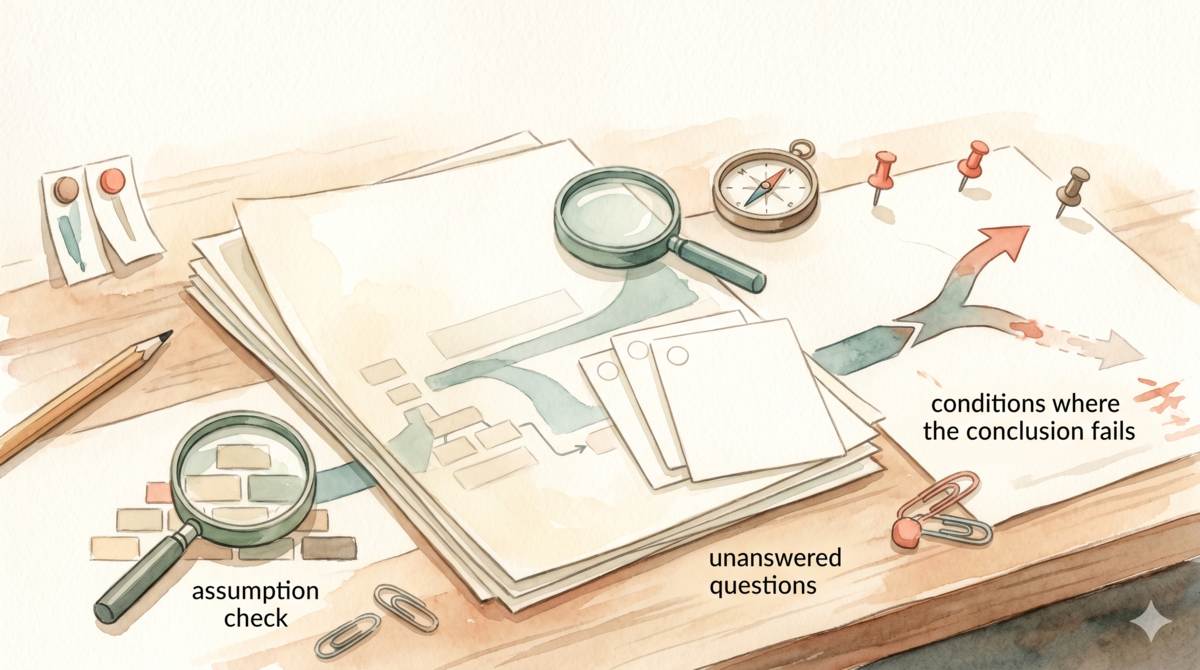
Watercolor style: a translucent stack of papers on a desk with three follow-up checkpoints, symbolizing hidden assumptions behind AI answers

Advanced Follow-Up: 3 Questions That Expose AI's Hidden Assumptions

The previous post was about how long conversations drift. After writing it, I noticed something else: drift does not only happen after a conversation gets long. It can also happen inside any answer that looks complete. AI answers quickly, and its conclusions often sound smooth. But it rarely says upfront: what assumptions does this conclusion depend on? If those assumptions are not checked, I end up accepting them by default. Accept enough unchecked assumptions, and the later analysis may be built on the wrong foundation. ...

2026-05-24 · 3 min · Alex Wang
Watercolor style: a winding paper trail across a desk, with three stations symbolizing mixed directions, data citation errors, and requirement bleed-through

Long Conversation Failures: Lessons from 3 Drift Disasters

The previous exercise was to run a 15-turn conversation with AI, using progress summaries and new conversations as checkpoints. If you actually did it, you probably noticed something else too: drift doesn’t always look the same. The three cases below are all failures I’ve run into myself. Here’s what happened, why it happened, and how to avoid it. Failure 1: Work Directions Got Mixed Together What Happened I was figuring out the approach for a project. I first discussed Approach A with AI, building a data dashboard. After 4 turns, it didn’t feel deep enough, so I switched to Approach B, automated reports, for another 3 turns. Then I thought maybe I could combine Approach C’s real-time push capability. Three directions kept jumping around in the same conversation for a dozen turns. ...

2026-05-23 · 7 min · Alex Wang
Watercolor style: a winding river flows from upper left to lower right, with a small ferry crossing marker in the middle, symbolizing a progress calibration point in a long conversation

Today's Practice: A 15-Turn Conversation Experiment

Today’s Practice Pick a real multi-step task you have on hand, and hold a conversation with AI for at least 15 turns (one question + one answer = one turn). Example tasks: “Help me plan a family trip (destination, itinerary, budget, packing list)” “Help me set up a personal blog from scratch (pick a platform, choose a theme, write the first post)” “Help me analyze a career decision (take stock of where I am, pros and cons, action plan)” Let the conversation unfold naturally without forcing strict structure at first, but do pause around turn 10 and run the progress-summary checkpoint. Send this message: ...

2026-05-22 · 2 min · Alex Wang
Watercolor illustration: two people across a large table covered in notes and sketches, deep in discussion, symbolizing iterative collaboration through multi-turn conversation

AI Path L0→L1 Upgrade Guide (3): Turning AI Into Your Collaboration Partner

📖 This is Part 3 of 5 in the “AI Path L0→L1 Upgrade Guide” series. Part 1: Understanding Your Tools · Part 2: From Vague Questions to Precise Instructions · Part 3: Turning AI Into Your Collaboration Partner · Part 4: Building Your Personal System · Part 5: Graduation & Next Steps TL;DR: Three core skills — follow-up iteration (the first answer is almost never the best), context management (periodic summaries, start fresh after ~20 turns, split complex tasks), and role-playing (assigning a role changes output depth). This week’s practice focus: deliberately run a 15+ turn long conversation and proactively do a progress summary. ...

2026-05-21 · 8 min · Alex Wang
Watercolor style: six molds in a row, each labeled with a different geometric shape, symbolizing different output format constraints

Format Constraints Cheat Sheet: 6 Prompt Templates for Ready-to-Use AI Output

Tip Card: Format Constraints Cheat Sheet Spend 10 seconds specifying a format in your prompt, save 10 minutes of reformatting afterward. Here are 6 of the most useful format constraints, each with a prompt template you can use right away. 1. Markdown Table Best for: structured information that needs comparison or summarization. “Output as a Markdown table with the following columns: Name, Description, Use Case, Notes.” 2. Numbered List Best for: steps, key points, quick scanning. ...

2026-05-20 · 2 min · Alex Wang
Watercolor style: three guide lines in signal-light colors converging on a door — green labeled reasoning, yellow labeled trade-offs, red labeled assumptions — symbolizing the three signals that trigger CoT

When Should You Ask AI to 'Think Step by Step'? Three Signals

Tip Card: When Should You Ask AI to “Think Step by Step”? Adding “please reason step by step” at the end of your prompt: that’s Chain-of-Thought (CoT). Deceptively simple, yet remarkably effective in the right situations. The question is: when should you add it? The answer is straightforward. Watch for three signals. If any apply, add it. Signal 1: The Problem Requires Multi-Step Reasoning “If I save $1,000 per month at a 4% annual interest rate compounded monthly, how much will I have after 10 years?” ...

2026-05-19 · 2 min · Alex Wang
Watercolor style: a workbench with five woodworking sketches progressing from rough to refined, symbolizing how the same request gets rewritten from vague to precise

RBGO Rewrites in 5 Real Scenarios: Vague Prompt vs. Precise Prompt

The previous post covered the RBGO (Role-Background-Goal-Output) framework. But there’s a gap between knowing the framework and actually using it: how do you translate “I want…” into those four elements? Below are 5 common everyday scenarios. Each one starts with the vague version (what most people actually write), followed by the RBGO rewrite, and finally a breakdown of what changed and why. Scenario 1: Writing a Work Email Vague version: ...

2026-05-18 · 5 min · Alex Wang